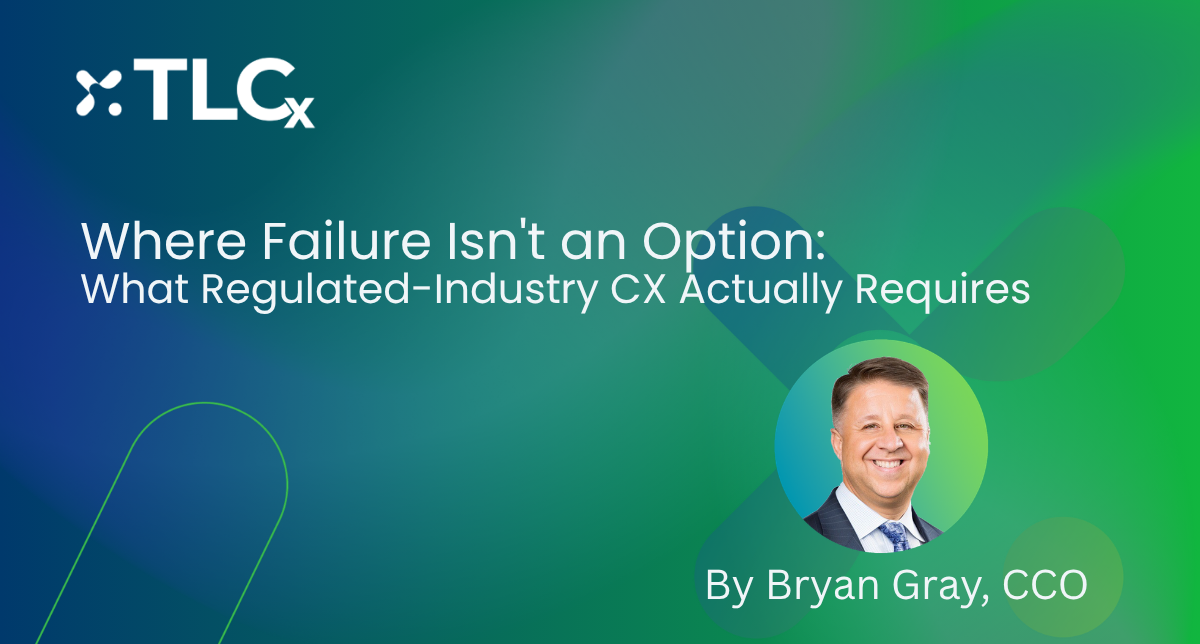
In regulated industries, a bad customer interaction isn’t just a bad customer interaction — it’s a compliance event, an audit finding, a penalty exposure, or in healthcare, a patient safety question. In “Where Failure Isn’t an Option,” TLCx Chief Commercial Officer Bryan Gray lays out why that changes what “vendor evaluation” has to mean for buyers in healthcare, government, and financial services — and what a Customer Experience partner has to prove before they’re trusted with the account.
Most CX vendor conversations are still won or lost on cost per contact and cultural fit. Bryan Gray argues that in regulated environments, that’s necessary but nowhere near sufficient. The real diligence questions are about certification, audit trails, escalation discipline, and what happens when volume spikes beyond anyone’s forecast — because in these sectors, it eventually will.
Three things are true in regulated CX that aren’t true everywhere else, Bryan Gray writes: the cost of a mishandled interaction is regulatory, not just reputational; volume is unpredictable in ways standard forecasting models don’t capture; and buyers aren’t just evaluating a vendor’s team, they’re evaluating its governance.
So what separates a partner who’s actually ready for regulated work from one who only sounds ready? Bryan Gray points to precision on three fronts: certifications held (like SOC 2 and PCI-DSS, independently audited and issued directly to the vendor), regulations complied with (like HIPAA and IRS Publication 1075, operating obligations rather than issued certifications), and authorizations inherited through the underlying platform (like FedRAMP and GovCloud, delivered through cloud infrastructure rather than held directly). “A partner who can’t draw this line clearly for you,” Bryan Gray writes, “hasn’t done the work to understand it themselves.”
In healthcare, Bryan Gray reframes CX as trust infrastructure rather than a standalone service line — patients don’t separate care quality from service quality, so a confusing billing call erodes trust the same way a clinical misstep does. A regulated-ready healthcare partner needs HIPAA, CMS, and state-level requirements embedded by design across the full patient journey, with automated compliance checks running on every regulated interaction, not a sample.
In financial services, Bryan Gray applies the same standard: experience quality should be measurable, monitored, and defensible under examination, just like any other regulated asset. The benchmark that matters is full monitoring coverage — AI-driven quality intelligence reviewing every regulated interaction, not a sample — which he says buyers should be requiring, not requesting.
Across all three sectors, Bryan Gray identifies a common thread among partners who perform under real pressure: a precise, honest account of what’s certified, complied with, and inherited; audit trails covering every regulated interaction; and an ownership and culture model that rewards getting it right over getting through the call. He also points to ownership structure as a legitimate diligence point — a veteran-owned, employee-owned operator has a structurally different relationship to mission-driven precision than a private-equity-backed vendor optimizing for a five-year exit.
Bryan Gray closes with five questions buyers should ask any regulated-industry CX partner: whether each compliance item is held, complied with, or inherited; what percentage of regulated interactions are actually monitored; how the vendor responded the last time volume exceeded forecast by 30% or more; what the documented escalation path is when an interaction touches compliance risk; and whether they can produce a reference account tested under real operational pressure, not just onboarded smoothly.