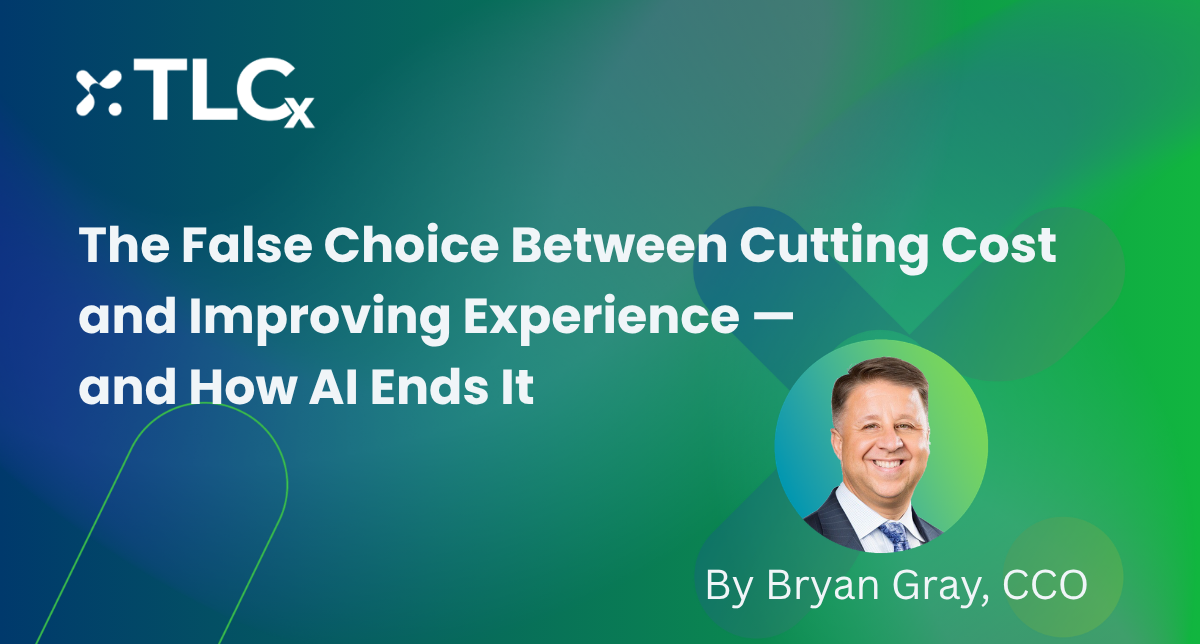
In “The False Choice Between Cutting Cost and Improving Experience — and How AI Ends It,” TLCx Chief Commercial Officer Bryan Gray takes on an assumption that’s shaped the outsourcing industry for decades: that cost and customer experience are locked on opposite ends of the same lever. Cut costs, and quality drops. Improve quality, and costs go up. Bryan Gray argues that constraint is finally breaking — not because AI is magic, but because of a very specific thing it changes: where labor cost actually shows up in an operation.
Here’s the logic. When routine, repeatable customer interactions get handled by intelligent automation instead of a person working from a script, the labor cost tied to those interactions drops. But in a well-designed model, the agents who used to handle that routine work don’t get cut. They get redeployed — to the complex calls that used to be rushed, under-resourced, or handled by whoever happened to be free instead of whoever was actually best suited for the job. Labor cost falls on the routine stuff. Experience quality rises on the stuff that actually matters. Same investment, better outcome on both sides.
Bryan Gray backs this up with real numbers from regulated enterprise transformations where the operating model was rebuilt around AI, not just layered with it: hundreds of thousands of dollars in annual savings, multimillion-dollar gains from payment and process optimization, double-digit improvements in billing efficiency, consistently strong First Call Resolution on complex interactions, and quality scores above 95%. He points to McKinsey’s 2024 research on this exact pattern — companies that redesign their workforce model around AI outperform the ones that just treat automation as a way to cut headcount.
But there’s a catch, and it’s the heart of the article: augmenting agents is not the same as just automating work. Real augmentation means building AI that actually makes agents better — real-time guidance that surfaces the right answer mid-call, unified customer data so people stop repeating themselves, and quality monitoring that reviews every interaction instead of a small sample. Skip that redesign, and you don’t break the cost-experience trade-off. You just relocate it. Handle time drops, cost drops, and experience quietly gets worse anyway — because the capacity AI freed up got cut instead of reinvested. Bryan Gray calls this the single most common reason enterprise AI projects deliver the savings but not the experience gains they promised.
He’s also clear that this isn’t really a technology problem — it’s a leadership one. Companies still stuck in the old cost-vs-experience trade-off usually bought the AI tools without rebuilding the workforce model around them. Breaking the trade-off means finance and operations leaders agreeing upfront on how efficiency gains get split — some to margin, some back into better service. Bryan Gray points to a real example: a regulated enterprise where the AI was already in place, but a leadership intervention — restructuring AI governance, rebuilding coaching frameworks, redesigning QA — drove a 20% month-over-month increase in ACH conversions. The technology hadn’t changed. The leadership decisions around it had.
The article ends with a pointed challenge for anyone evaluating a CX or AI partner heading into 2H 2026. Stop asking “how do you cut costs” and “how do you improve experience” as two separate questions — that framing already accepts the old trade-off before the conversation even starts. Ask one question instead: how does your AI-augmented model deliver both, from the same investment, and what’s your actual track record proving it? If a partner can only answer half of that with real evidence, Bryan Gray says, they’re still selling the old trade-off with new technology bolted on top. As he puts it: AI doesn’t change what great customer experience costs — it changes what’s possible at any given cost. The lever is gone. The only question left is what you build in its place.