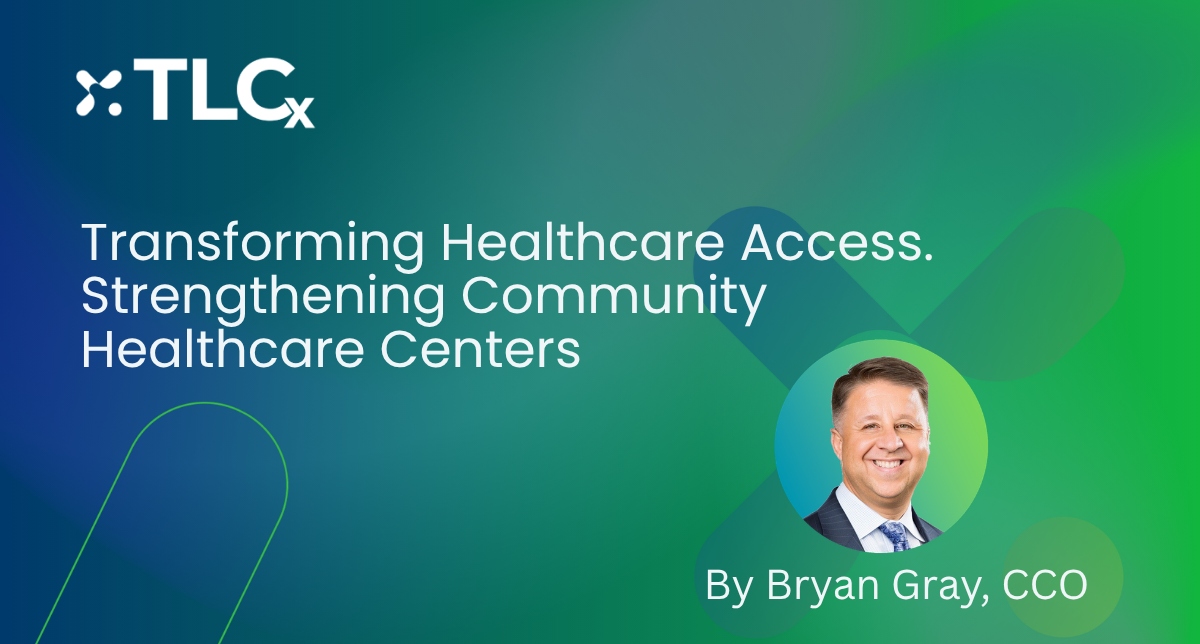
Community Health Centers are the backbone of accessible healthcare in the United States, providing essential primary and preventive care to underserved populations who often have nowhere else to turn. In “Transforming Healthcare Access. Strengthening Community Healthcare Centers,” TLCx — in partnership with Commonwealth Purchasing Group (CPG) — lays out how it’s helping these centers build the scalable, patient-first access infrastructure needed to meet a defining moment for community healthcare.
The piece opens by naming the “perfect storm” facing CHCs nationwide: rising patient volumes straining capacity, persistent staffing shortages, limited technology budgets that leave centers reliant on aging systems, growing patient expectations for seamless digital interaction, and increasingly complex regulatory requirements. TLCx is direct about the stakes — these aren’t abstract operational issues, but daily realities that determine whether patients get timely care or fall through the cracks.
At the center of the article is a simple but powerful thesis: access is everything. Every scheduled appointment, delivered reminder, accurate eligibility check, and empathetic care coordination call is a micro-interaction that determines whether a patient receives the care they need. TLCx frames its role not as traditional outsourcing — which it argues often creates distance between patients and care teams — but as genuine operational transformation, embedding its people, processes, and technology as an extension of each health center’s own team.
That transformation follows a clear path: assessment of current patient access workflows, a rapid TLCx LaunchPad™ pilot program, and expansion to full-scale operational transformation. TLCx’s healthcare-focused services span patient scheduling support, eligibility verification, appointment reminders and outreach, care coordination assistance, AI-assisted quality assurance, and digital engagement through text, chat, and portal channels — all governed by healthcare-specific protocols where accuracy, compliance, and empathy are treated as non-negotiable.
A key theme throughout is Human + AI Integration. TLCx is explicit that the goal isn’t replacing healthcare staff with automation — it’s augmentation: giving healthcare professionals AI scheduling assistants, intelligent automation for routine workflows, AI-assisted QA systems, and structured transformation roadmaps that let them serve more patients, more effectively. Underpinning all of this is a compliance-ready infrastructure — HIPAA-compliant data protection across U.S. and nearshore operations, backed by CPG’s vetted vendor framework, which reduces procurement complexity and risk for health centers that often lack the resources to evaluate enterprise-grade solutions on their own.
The results TLCx reports are substantial: a 40% reduction in call abandonment, a 25% reduction in no-show rates, a 30% improvement in revenue cycle performance, and a 35% increase in patient satisfaction. But the article is careful to keep the focus on what those numbers represent — a mother securing a prenatal appointment, a veteran navigating benefits enrollment, a child receiving a timely immunization.
The piece closes by tying this work to TLCx’s identity as a veteran-owned organization committed to workforce development and community investment, describing a “virtuous circle” where strong employees drive strong operations, strong operations enable strong health centers, and strong health centers build stronger communities. As TLCx puts it: when access improves, lives improve — and that’s a mission worth investing in.
Download the Insight: Transforming Healthcare Access for Community Health Centers