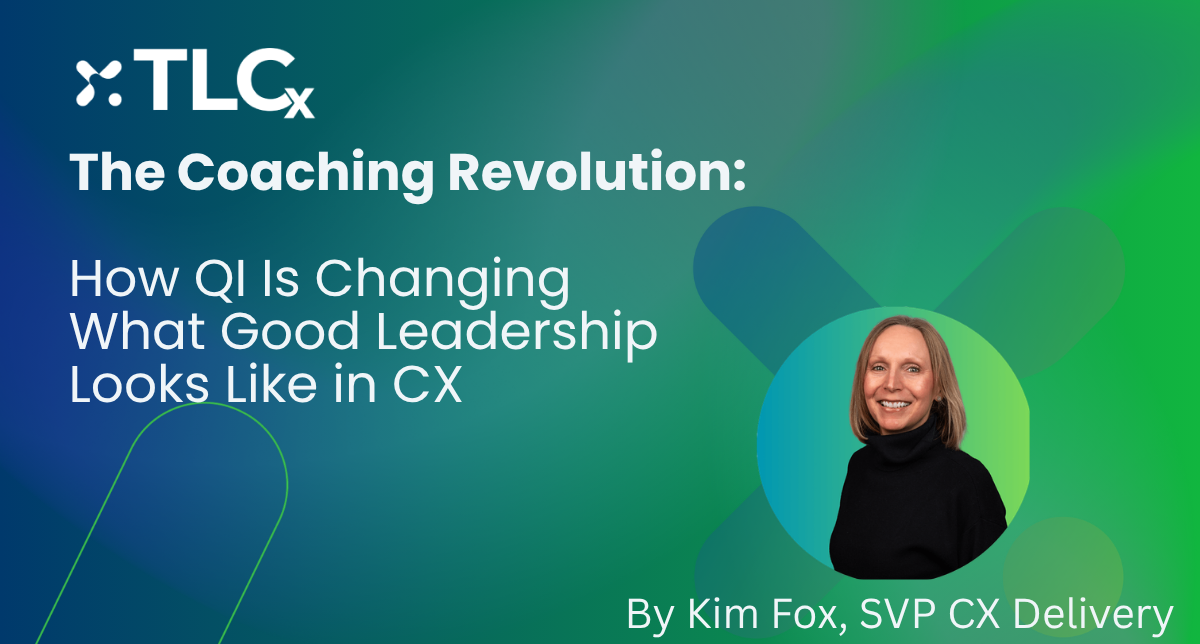
In “The Coaching Revolution: How QI Is Changing What Good Leadership Looks Like in CX,” TLCx SVP of CX Delivery Kim Fox starts with a number that should stop any CX leader in their tracks: most traditional quality assurance programs only manually review 2-5% of calls. Out of every hundred conversations your agents have with customers, 95 to 98 of them are never seen by anyone. Kim Fox doesn’t mince words about what that actually is — not a quality program, but a sampling exercise with a quality program’s budget. It’s been this way for decades, not because companies didn’t want better visibility, but because reviewing every call by hand was simply too expensive.
That’s what TLCx QI is built to fix. QI is the quality intelligence layer inside TLCx LaunchPad, and it reviews 100% of interactions — every call, every chat, every email — scoring and flagging them and feeding the results back into the system in real time. Kim Fox notes the compliance benefits are obvious, but the bigger shift is what full coverage does to management itself. When supervisors could only see a sliver of what was happening, quality programs were stuck being backward-looking and reactive. QI rewires that completely.
The article’s central idea is a shift from what Kim Fox calls the “Inspector Model” to the “Coach Model.” Before QI, managers were looking for problems after the fact, calibrating scores off a handful of sampled calls, and reacting to exceptions as they came up — always asking “what went wrong in the calls I happened to review?” With QI, managers work from real data across every single interaction. They spot patterns, they know exactly where to focus their coaching energy each week, and their feedback is grounded in real evidence instead of a guess. Kim Fox is clear that this shift matters for everything — performance, retention, culture, and ultimately the actual experience a team delivers to customers.
Kim Fox also takes care to head off a common misunderstanding: QI is not surveillance. It’s not a tool for catching agents doing something wrong — it’s a tool for helping people get better at their jobs. Feedback grounded in a real interaction an agent actually had (not a hypothetical, not a random sample) lands differently and actually changes behavior. And the agents who do best in QI-enabled environments aren’t the ones being watched most closely — they’re the ones who feel most supported. That difference shows up directly in CSAT and retention numbers.
The article backs all this up with concrete numbers: 100% interaction coverage, zero invisible interactions, and a 3x increase in coaching cadence as managers move from reactive firefighting to proactive, pattern-based development. Within the broader LaunchPad ecosystem, QI isn’t a standalone tool — it feeds directly into Engage AI (coaching prompts and performance signals for agents) and Customer 360 (connecting quality data to the full customer experience), creating a continuous loop where every interaction becomes a source of organizational learning.
Kim Fox closes with a direct message to any CX leader who’s accepted 2-5% call coverage as just how things are: the business case for change is clear. Full coverage means catching risk earlier, coaching that compounds instead of resetting, and compliance confidence that doesn’t depend on hoping the right calls got sampled. As she puts it, QI doesn’t replace human judgment — it gives that judgment better material to work with, and managers more time to actually manage.