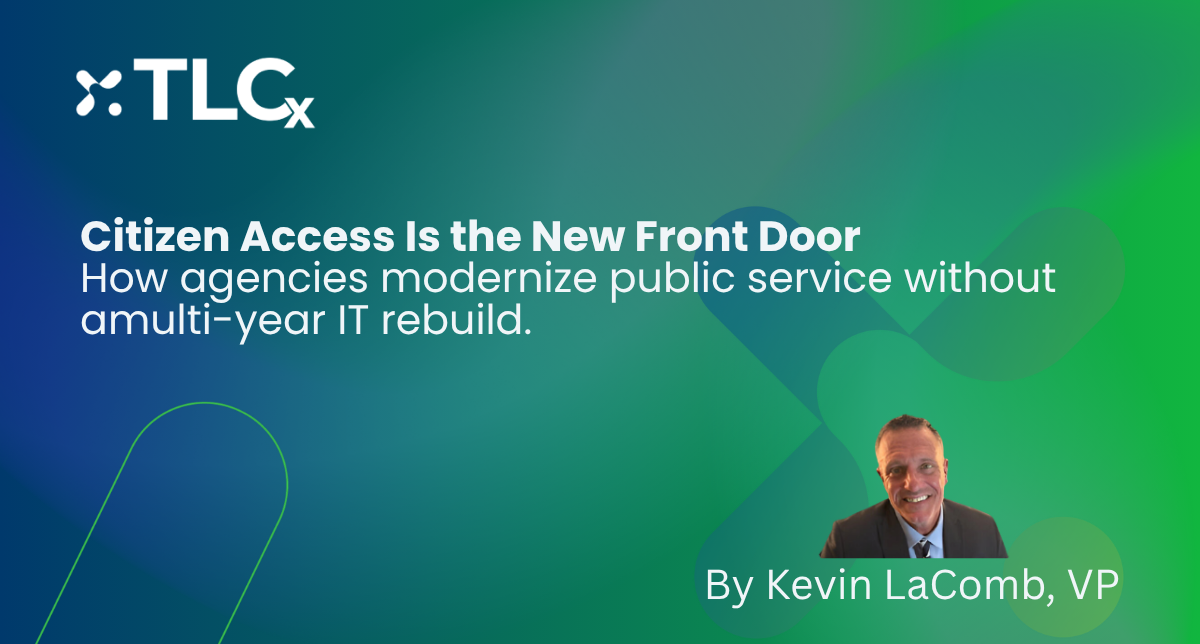
A citizen doesn’t experience an agency as an org chart. They experience a hold time, a portal that asks them the same questions twice, a letter that contradicts the call, and a caseworker who can’t see what happened yesterday. In “Citizen Access Is the New Front Door,” TLCx makes the case that this — not the org chart — is the real front door of government, and for most programs it’s still three disconnected shops: the contact center, the website, and the back-office queue.
The paper’s core argument is blunt: digitizing a form is not citizen experience, and replacing a core system is not a service strategy. The agencies that earn trust over the next twenty-four months, TLCx argues, will be the ones that treat access itself as the product — and prove it on one program before trying to boil the ocean.
TLCx points out that the problem isn’t only technology. Benefit lines spike after a policy change. Licensing portals time out. Unemployment claims pile up because identity documents can’t be verified in the same sitting as the application. Disaster lines open overnight and the standing workforce can’t absorb them. The usual answer — a multi-year modernization with a new CRM, new core, new vendor, new integration layer — matters, but it also stalls: budget cycles, security reviews, labor agreements, and systems that can’t be taken offline all get in the way. While those programs stall, abandonment rises, first-contact resolution falls, and trust leaks out of the institution one unanswered call at a time.
TLCx frames this as the same shift already underway in healthcare and banking: citizen experience is now judged by whether someone got through, whether they had to start over, whether a human understood the urgency, and whether they were treated fairly — not just by transaction counts. The paper draws directly on TLCx’s work with community health centers, where the fix wasn’t a core-EHR replacement but a structured access layer covering intake, scheduling, follow-up, and quality — stood up without waiting for a five-year build. Government programs, TLCx argues, have the same physics: high volume, high consequence, fragmented systems, and a public that won’t wait for the next appropriation.
The paper lays out a six-capability government access stack that most agencies already need, working as one journey: citizen service helplines that are always on and multilingual; application processing that captures a complete file the first time; document verification that doesn’t ask claimants to resubmit what they already uploaded; benefits and grant support that explains status in plain language and escalates when a rule — not a queue — is the blocker; appointment scheduling; and policy information that’s consistent across letter, web, chat, and voice. TLCx positions its own LaunchPad™ platform as that modular layer — with Engage AI™ guiding agents in the moment, Citizen 360™ giving a single cross-channel view of each person, and QI™ reviewing quality and compliance on the interaction itself rather than three months later in a sample — none of which requires replacing the core system first.
Rather than pitching transformation, TLCx recommends a 90-day pilot built around five steps: pick the front door that hurts most (unemployment status, SNAP recertification, licensing, disaster intake — whichever line citizens already blame the agency for); stand up the access layer beside the core rather than waiting for a platform migration; instrument the journey with metrics that can be reviewed weekly, including abandonment, first-contact resolution, and repeat-contact rate; publish the results inside the agency so program leadership, legal, labor, and finance all see the same dashboard; and only then scale to a second channel or program.
TLCx offers four questions to define what “good” looks like: Can a citizen complete the most common request without repeating their identity three times? Can an agent see the last interaction, the open case, and the governing rule in one place? Can leadership defend the quality of every channel with an audit trail? Can the operation surge for a storm, a policy change, or a filing deadline without collapsing the standing team? These are operational questions, TLCx notes, but they’re also political ones — when the answer is no, the agency doesn’t have a technology gap, it has a trust gap that gets explained for it on the evening news.
The paper closes with a note on what public-sector delivery actually requires from a partner: not commercial outsourcing with a new cover sheet, but mission work under statute, scrutiny, and labor reality. TLCx describes itself as a certified veteran-owned operator applying the same posture it uses in healthcare — human at the core, technology as amplification, results that can be shown to a board or a legislature without translation. “The front door is already open,” the paper concludes. “The only question is whether the agency will keep asking citizens to wait in it, or whether it will treat access as the service it actually is.”