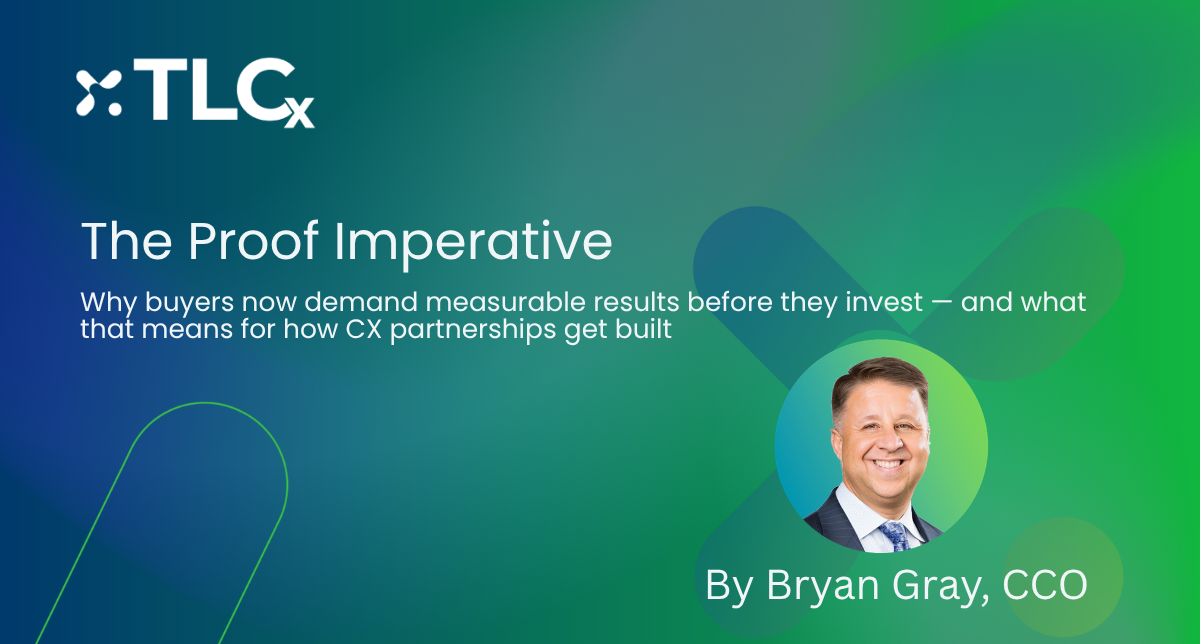
Buying a CX partner used to be easy to sell on a good story. Not anymore. In “The Proof Imperative,” TLCx Chief Commercial Officer Bryan Gray explains why. Today’s buyers — CFOs, COOs, procurement teams who’ve been burned before — want proof before they’ll even take the call. They want to see real clients running at scale, real AI results (not just a roadmap), and results from week one, not promises for year three.
Bryan Gray calls this shift the proof imperative. For years, CX vendors could win deals on relationship and reputation, because switching vendors was rare and buyers couldn’t easily compare providers. That’s changed. Buyers now talk to peers, read analyst reports, and remember every vendor who overpromised. Words like “cutting-edge” and “best-in-class” don’t carry weight anymore. What buyers want instead is a vendor willing to show real numbers before the contract is signed.
So what counts as real proof? Bryan Gray breaks it into four things: quantified case studies (actual dollar figures and percentages, not vague claims), framework-linked outcomes (results that come from a repeatable process, not a lucky team), measured AI impact (what the AI actually did, not what it’s capable of doing), and referenceable clients who’ll vouch for the results directly — which Bryan Gray says is the hardest one to fake.
To back this up, TLCx shares some of its own numbers: over $3.5 million in savings from one billing and collections program. A federal contract where TLCx went from zero to 370 trained, background-checked staff across three sites in just four weeks, then hit a 90% customer satisfaction target within 90 days. Handling almost two million calls a yearwhile keeping quality scores near 95% and first-call resolution above 86%. And one client that had worked with seven outsourced vendors — and narrowed it down to two, ranking TLCx first in every category.
Bryan Gray’s answer to all this is pilot-first engagement. Instead of asking a buyer to commit to years of transformation on faith, prove the model works on a smaller scale first — then grow from there. It’s faster to get approved, it uses the buyer’s own data instead of a reference account, and it replaces “trust our roadmap” with “measure our results.”
He’s clear this isn’t just a TLCx thing — it’s happening across the whole industry. Every CX vendor is going to be asked to prove their results, not just describe them. The vendors who already have that proof ready will move faster and win more deals. As Bryan Gray puts it, the real question buyers are asking now isn’t “can you do this?” — it’s “can you prove you already have?”
Download the Insight: The Proof Imperative: Why CX Buyers Now Demand Evidence