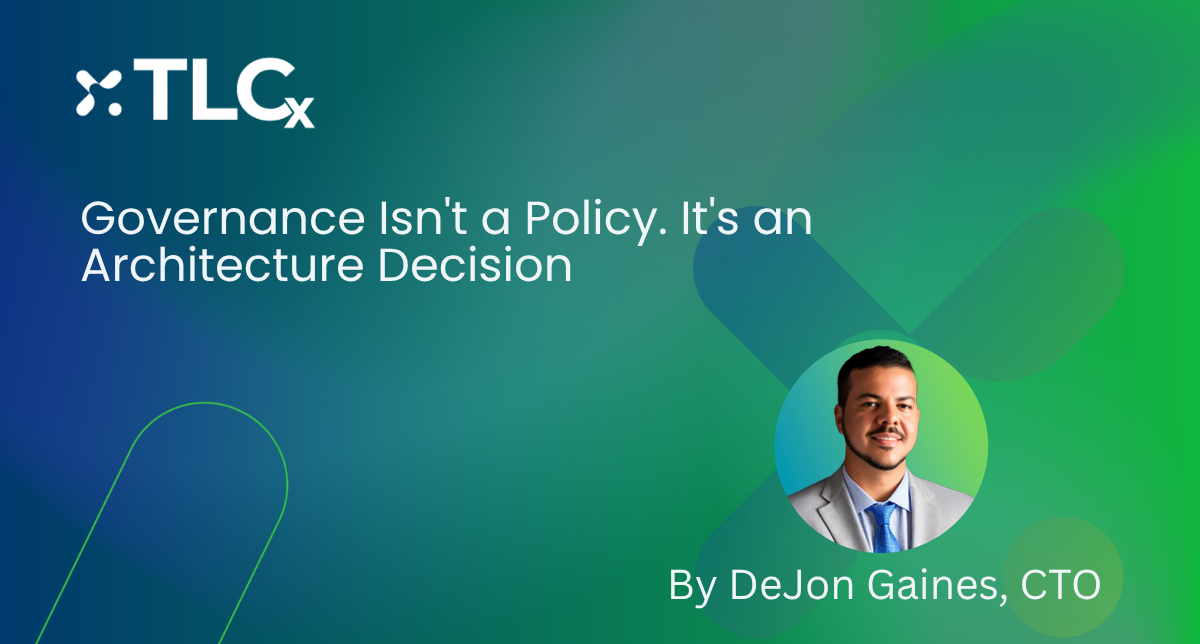
Governance Isn’t a Policy. It’s an Architecture Decision.

In “Governance Isn’t a Policy. It’s an Architecture Decision,” TLCx Chief Technology Officer DeJon Gaines pushes back on how most companies think about AI governance. Most conversations about it happen way too late — after the AI is already live, usually kicked off by a regulator’s question, an audit finding, or a customer complaint that exposes a gap nobody thought to check for beforehand. DeJon Gaines says that order is backwards, and it’s quickly becoming the real thing that separates vendors who are actually ready for regulated buyers from vendors who’ve just said they are.

He draws a clear line between two approaches. Governance by design means the architecture itself enforces the rules — what data a model can see, what decisions it can make on its own versus hand off to a person, and what audit trail exists for everything it does. Governance by policy means relying on documents, training sessions, and catching problems after they’ve already happened to a real customer, patient, or citizen. DeJon Gaines is blunt about why this matters: a system built for governance from the ground up can prove compliance to an auditor on demand, with evidence. A system governed only by policy layered on top can only promise compliance and hope people are actually following it. One’s an engineering guarantee. The other’s a hope.

For anyone buying AI in a regulated space — banking, healthcare, government — DeJon Gaines lays out three questions that need to be part of vendor evaluation, not something left for legal review after the technical decision’s already made:

  1. Data access boundaries — what can the model actually see, and what’s it structurally blocked from seeing? Not by policy. By design.
  2. Audit trail on demand — can the vendor produce a complete, verifiable trail for a specific decision from six months ago, right now, for a regulator?
  3. Uncertainty escalation — when the system genuinely doesn’t know the right answer, does it hand off to a human, or does it just proceed and log what happened?

DeJon Gaines is clear these aren’t questions a sales team can answer off a slide deck. He backs this up with a real example: a regional bank running an AI-driven loan decisioning system got a request from regulators for a full audit trail on a transaction from the prior quarter — model inputs, confidence scores, every escalation step. The vendor delivered it in under four hours. That wasn’t something built for the audit. It was there from day one.

There’s also a cost argument most buyers underweight. Retrofitting governance into a system that wasn’t built for it often means re-architecting core parts of it, not just adding a policy layer. Companies that pick a vendor purely on capability and push the governance conversation to later often find out how expensive that retrofit is only after they’ve already signed. And the good news, according to DeJon Gaines, is that none of this requires sacrificing capability — the best-designed systems just treat governance as a constraint from the first sketch, the same way a well-designed building treats structural safety.

He closes with a longer-term view: as AI becomes standard infrastructure everywhere, competitive advantage won’t come from just deploying AI — it’ll come from deploying AI that enterprises can actually trust. And that trust gets measured not by what a system can do, but by what it’s architecturally prevented from doing wrong. The executives who ask architecture questions during vendor evaluation, not just compliance questions, are the ones who won’t be blindsided later by what their AI actually does in production.

Download the Insight – Governance Isn’t a Policy. It’s an Architecture Decision


FAQ's - Governance Isn’t a Policy. It’s an Architecture Decision.

What's the difference between "governance by design" and "governance by policy" in AI systems?
According to TLCx Chief Technology Officer DeJon Gaines, governance by design means the architecture itself enforces boundaries — what data an AI model can access, what decisions it can make autonomously versus escalate to a human, and what audit trail exists for every action. Governance by policy, by contrast, relies on policy documents, training sessions, and after-the-fact monitoring to catch problems once they’ve already happened in production. DeJon Gaines states the difference isn’t cosmetic — it’s a question of what the system is architecturally capable of doing wrong.
TLCx argues most conversations about AI governance happen after the technology is already in production, typically triggered by a regulator’s question, an audit finding, or a customer complaint that surfaces a gap no one checked for in advance. DeJon Gaines calls this sequencing backwards, and states it’s becoming a genuine, measurable differentiator between vendors who are actually ready for regulated buyers and vendors who have simply announced that they are.
TLCx identifies three architecture questions that belong at the center of vendor evaluation, before a contract is signed: (1) Data access boundaries — what data does the model actually see, and what is it structurally prevented from seeing, not by policy but by design? (2) Audit trail on demand — can the system produce a complete, verifiable audit trail for a specific automated decision from six months ago, on demand, for an external regulator? (3) Uncertainty escalation — when the system is genuinely uncertain, does it escalate to a human, or does it proceed and log the outcome? TLCx states these are architecture questions, not compliance checkbox questions a sales team can answer from a slide.
TLCx states that adding fine-grained data access controls to a system that was never architected for them often requires re-architecting core components, not simply adding a policy layer on top. Buyers who select an AI vendor based purely on capability, deferring the governance question to a later phase, frequently discover this cost only after they’re contractually committed — and the retrofit becomes their problem too, not just the vendor’s. TLCx describes this cost gap as structural, not marginal, based on its experience across regulated enterprise deployments.
No. TLCx states that a well-governed architecture does not trade away capability to achieve governance. The best-designed systems treat the governance boundary as a design constraint from the earliest architectural decisions — similar to how a well-designed building treats structural safety requirements, not as a limitation fought against, but as a parameter the entire design works within from the first sketch.
TLCx cites the example of a large regional bank that deployed an AI-driven loan decisioning system. When regulators requested a full audit trail for a specific transaction from the prior quarter, the vendor produced it in under four hours, with complete model inputs, confidence scores, and escalation logic documented at every step. TLCx states this capability wasn’t added for the audit — it was designed in from the start, which it calls a meaningfully different engineering posture from vendors who bolt on governance late in the roadmap.

About TLCx

At TLCx, our people-first philosophy isn’t just a slogan — it’s the way we work. From leadership to the frontlines, every member of our team is committed to creating experiences that inspire, empower, and endure.

Because for us, customer experience isn’t a service.
It’s a partnership. A promise. A legacy in the making.

Services

Most Recent Posts

Redefining CX

TLCx is reshaping customer experience across industries by combining deep expertise with forward-looking innovation. Our services, real-world case studies, and innovation pillars demonstrate why organizations choose TLCx to drive meaningful transformation.

About Us

TLCx delivers people-first, AI-powered customer experiences—helping global brands transform journeys, drive loyalty, and achieve secure, seamless results.

TLCx @2026 Copyright