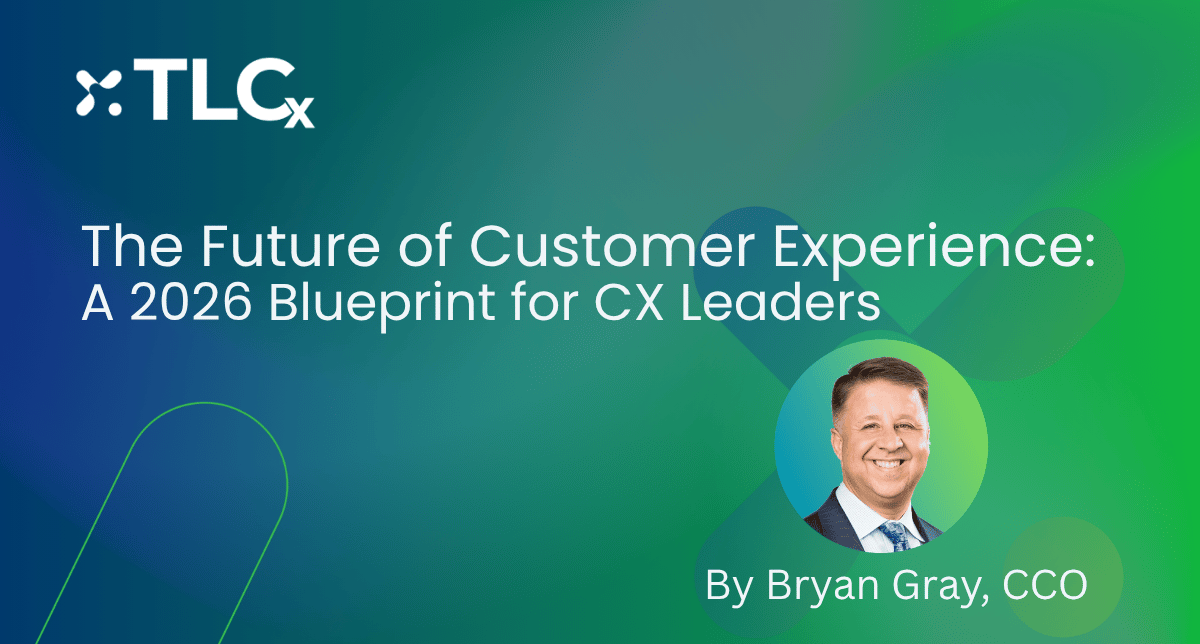
In “The Future of Customer Experience: A 2026 Blueprint for CX Leaders,” TLCx Chief Commercial Officer Bryan Gray offers an upbeat but honest look at what’s coming — the defining forces CX organizations will need to balance in the year ahead: intelligent automation, real-time insights, heightened regulatory scrutiny, and a renewed emphasis on human empathy. The brands that succeed, he argues, will be the ones that evolve their operating models with agility while staying deeply grounded in the fundamentals of service.
The piece opens with a claim that might sound counterintuitive at first: human connection will become a competitive advantage, not a casualty, of the AI era. As customer interactions become increasingly mediated by bots and automation, Bryan Gray makes the case those moments that feel personal and human become rarer — and more valuable. His framing is simple: the machine handles the complexity, the human handles the connection. He recommends organizations reinvest in frontline coaching focused on empathy and trust-building, redesign scripts to sound more conversational, and deploy AI to surface context and sentiment cues so agents can stay focused on the customer rather than juggling systems.
From there, Bryan Gray turns to automation itself, arguing it should be a “silent partner” that accelerates processes and reduces cost without sacrificing care — never a replacement for people. He lays out a three-step path: conduct a full process audit to find automation-ready tasks, prioritize high-ROI areas like agent assist, smart routing, automated QA, and digital self-service, and build an integrated automation layer rather than a patchwork of point solutions. Organizations that do this well, he states, can recapture 20-40% of operational cost and reinvest those savings into further modernization.
Trust gets its own extended treatment. Bryan Gray frames 2026 around two distinct kinds of trust customers and regulators will demand: whether customers trust a brand’s answers, data handling, and automated decisions, and whether regulators can get a clear explanation of how a brand’s AI actually behaves. He argues trust is shifting from a supporting attribute to a strategic differentiator, and recommends four concrete steps: strengthening compliance programs around standards like PCI, SOC2, and HIPAA; building explainable AI standards; increasing transparency around data usage and system handoffs; and evaluating vendor partners on governance and ethics, not just technical capability.
Operating models need to change shape too. Bryan Gray makes the case the future of CX isn’t a single fixed model — it’s a modular ecosystem that flexes with customer needs and business conditions, which is the thinking behind TLCx’s own LaunchPad framework. Rigid, seat-based outsourcing is fading in favor of hybrid delivery models, flexible contract structures, and independently activated capabilities like AI, analytics, and QA intelligence — treating CX as a living system rather than a static org chart.
Data, in Bryan Gray’s view, is the backbone of all of this — but only if organizations can actually turn it into action. He calls for breaking down data silos across CRM, telephony, workforce management, QA, and digital systems into a single intelligence platform, replacing random QA sampling with predictive, comprehensive quality monitoring, and building closed-loop systems where insights drive decisions and outcomes are measurable. As he puts it, the most successful CX organizations in 2026 will be the ones that turn data into foresight — enabling proactive service rather than reactive problem-solving.
Bryan Gray also argues CX itself needs to expand beyond the contact center. Customers don’t experience a company in departments — they experience one unified brand across digital journeys, logistics, billing, and product usage. That means aligning enterprise KPIs around retention and lifetime value, building cross-functional governance, and measuring customer effort rather than just handle time.
None of this happens without leadership, and Bryan Gray closes on culture: the most effective CX leaders in 2026 will be the ones who build AI confidence through coaching and transparency, replace large monolithic transformation projects with iterative pilots, reward curiosity and cross-functional collaboration, and bring frontline agents into strategy conversations, since they’re often closest to the customer reality.
The piece wraps up with four foundational principles for the year ahead: keep humans at the core, use technology to amplify people rather than replace them, build adaptive operating models, and lead with clarity and purpose. As Bryan Gray puts it, CX is no longer a back-office function — it’s the heartbeat of the brand and the engine of competitive advantage.
Download the Insight – The Future of Customer Experience: A 2026 Blueprint for CX Leaders