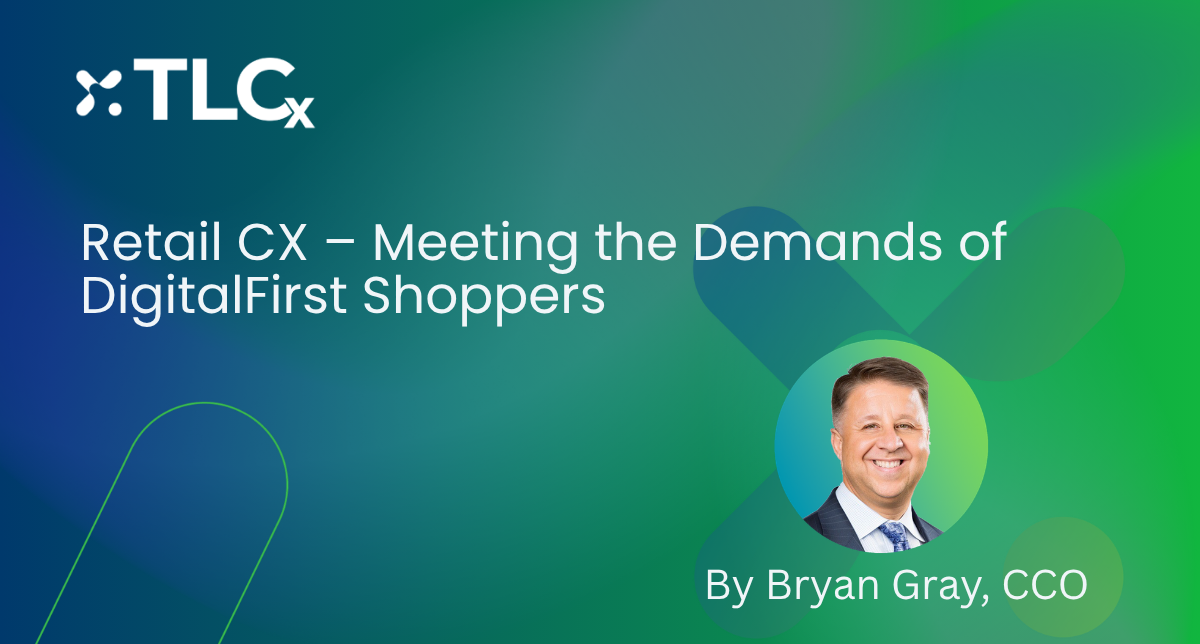
Today’s shoppers are digital-first by default, well-informed, and — as TLCx Chief Commercial Officer Bryan Gray puts it — impatient out of necessity. In *”Retail CX – Meeting the Demands of Digital-First Shoppers,”* Bryan Gray makes the case that this isn’t a passing trend caused by eCommerce growth or mobile adoption — it’s a real structural shift in what retail customer experience has to deliver. Shoppers no longer compare a retailer to its competitors. They compare it to the best digital experience they’ve had anywhere, from any brand.
The article breaks digital-first expectations down into three simple things shoppers want: instant support that solves problems in seconds (not necessarily from a human, but always effectively), personalization that’s actually relevant rather than generic or overly intrusive, and journeys that flow smoothly across channels, so a customer’s context follows them from mobile to desktop to in-store without getting lost. Bryan Gray points out what hasn’t changed, too — customers still want to feel understood and valued. Technology has just raised the bar for how consistently that has to happen.
He also lays out where retail CX strategies commonly go wrong: automating too much without guardrails, organizing teams around channels instead of the customer journey, personalization that reacts to the past instead of predicting what’s next, and treating CX as a pure cost center — a trap that ends up eroding quality and wiping out the very savings it was supposed to create.
TLCx’s answer is a philosophy it calls intelligent augmentation — deliberately built Human-AI Teams where AI handles speed, scale, and pattern recognition; humans handle judgment, empathy, and the exceptions that need a real person; and governance keeps the whole system trustworthy, compliant, and consistent. This carries into AI-driven personalization, where TLCx builds AI directly into frontline agent workflows instead of hiding it in a dashboard, so agents become “signal interpreters, not script readers” — turning personalization from a buzzword into something that actually moves the needle.
The article also covers how TLCx supports 24/7 omnichannel service across chat, voice, social, and messaging, and how it helps retailers connect eCommerce and in-store experiences by keeping customer context consistent across systems and giving store staff and contact center agents the same customer intelligence.
Finally, Bryan Gray introduces TLCx LaunchPad™, a modular framework built for retail’s naturally uneven growth — seasonal spikes, promotions, market expansion. LaunchPad lets retailers roll out intelligent augmentation, quality intelligence, and predictive personalization step by step, with governance built in as what he calls “the hidden differentiator” as AI systems get more autonomous. The article ends on TLCx’s core message: in modern retail, experience isn’t just part of the brand — it is the brand.
Download the Insight: Retail CX: Meeting the Demands of Digital-First Shoppers