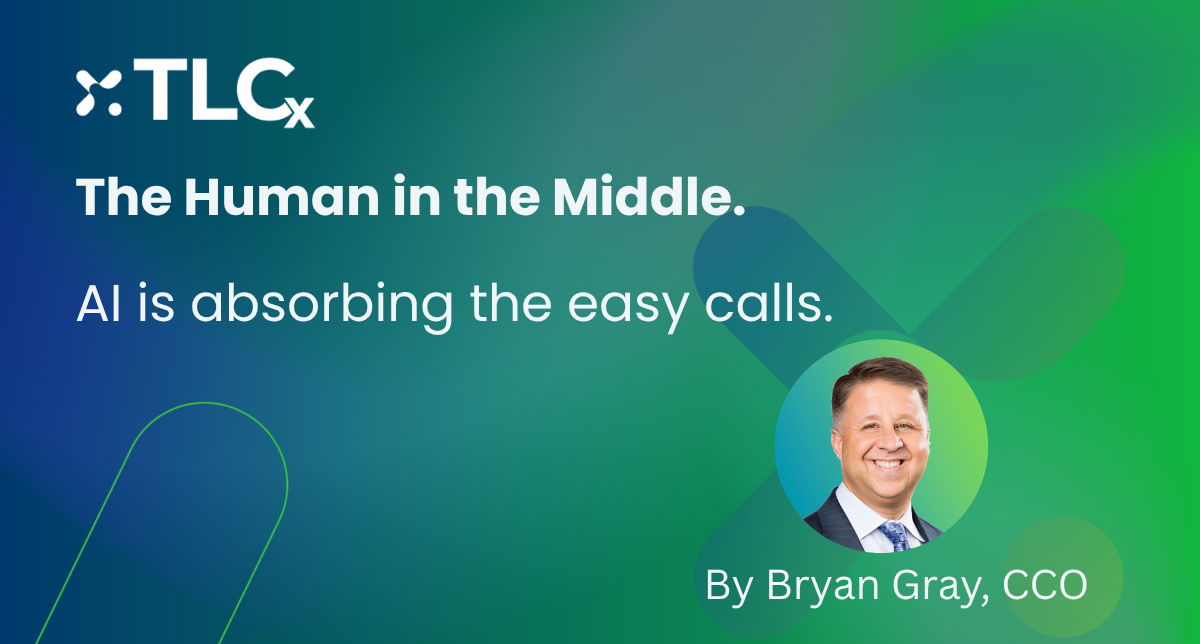
AI is taking on the easy calls. In *”The Human in the Middle,”* TLCx Chief Commercial Officer Bryan Gray argues that what’s left for people isn’t a smaller job — it’s a harder one, and it needs a different kind of agent, leader, and partner to get right.
Bryan Gray builds on a concept he heard repeatedly in a recent client conversation: “human in the middle.” The idea sounds simple — AI handles routine, transactional work, and people handle the conversations that need a person. Most service leaders agree with it in principle, Bryan Gray writes, but far fewer have worked through what it actually demands of their operation, their frontline, and their partners. The piece picks up where TLCx CTO DeJon Gaines’s “Where the Human Stays” left off: once a system knows where the human belongs, what does it take to make that person good at the job?
Bryan Gray illustrates the shift with a billing program TLCx supports, where AI now handles balance inquiries and standard payments — work that used to make up a steady, predictable share of agent volume. What reaches people now looks different: a customer being billed for both an old and new address, frustrated and justified in being so, with no script that covers the situation end to end. As AI absorbs the easy work, Bryan Gray writes, the human workload doesn’t get smaller — it gets harder, because every remaining interaction is by definition one the system couldn’t finish on its own.
He pushes back on picturing the human in the middle as a safety net or a handoff point. Instead, Bryan Gray describes the agent standing between three things at once: the system and the customer, translating what the AI already did so the customer never repeats themselves; the policy and the person, applying a general rule fairly to a specific case; and the brand and the relationship, since for many customers that one conversation decides whether they stay. “The human in the middle,” he writes, “is not where automation ends. It is where the relationship is won or lost.”
That shift changes what hiring, training, and tenure need to look like. Bryan Gray argues hiring has to test for judgment and de-escalation, not just system aptitude; training has to move from scripts to situations, giving new agents practice with the hardest calls rather than the easiest ones; and tenure matters more, because the knowledge that lets an experienced agent resolve a messy dispute in one call takes real time to build. He notes the same pattern is already visible in healthcare and patient access, where routine reminders move to automated channels and the calls that remain are the confused patient, the coordinating caregiver, or the frightened caller who needs to be heard first.
The shift also changes what’s asked of supervisors. Bryan Gray writes that when almost every call is a hard one, coaching has to focus on judgment — why an agent issued a credit, how they handled an angry customer’s first thirty seconds — not just scores. He flags a “measurement trap” leaders need to anticipate: as AI removes the shortest, simplest contacts, average handle time rises and volume per agent falls even when nothing about performance has changed. An operation still judging people on the old scorecard, he warns, will conclude they’re getting worse at exactly the moment they’re doing more valuable work. The fix is measuring the middle on what it’s actually there to do — resolving the problem in one contact, keeping the customer, and getting the judgment calls right.
Bryan Gray is direct that human in the middle only works if the person in the middle is allowed to finish the job. If an agent can only submit a request and tell the customer someone will follow up, he argues, the model has failed everyone involved. He recommends clients settle four questions early and in writing: what the agent can resolve on the call, when and to whom they escalate, what the AI hands over to the agent, and how the hardest calls get reviewed together.
That authority question extends to how companies should evaluate outsourcing partners. Bryan Gray argues that cost per contact and speed of answer still matter, but in a human-in-the-middle model, the partner is handling the interactions that most shape how customers feel about a brand. He adds three questions buyers should ask alongside the technology questions DeJon Gaines proposed: how a partner hires and trains for the calls AI can’t handle, how they measure people once automation changes the call mix, and what authority their agents will actually have to resolve problems on the call.
Bryan Gray closes with a wider claim about where the competitive advantage lies: the companies that win the next few years won’t be the ones that automate the most — they’ll be the ones that invest the most in what’s left, the people in the middle, the leaders who coach them, and the authority that lets them finish the job.