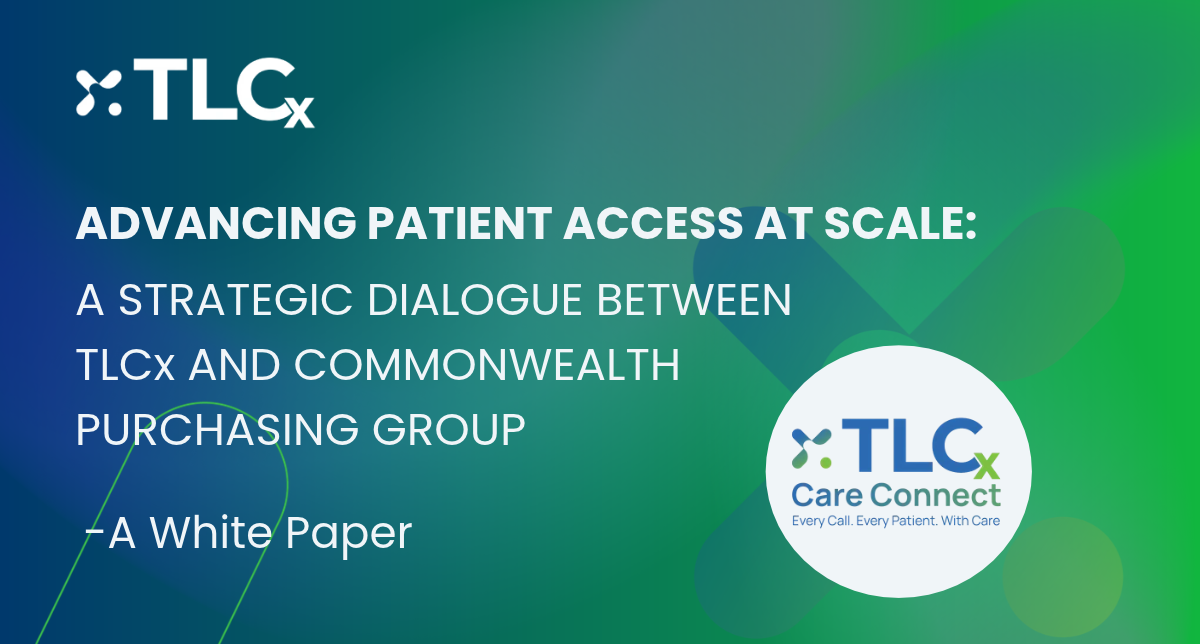
Patient access used to be treated as a scheduling problem. In “Advancing Patient Access at Scale,” a joint dialogue between TLCx and Commonwealth Purchasing Group (CPG), TLCx Chief Commercial Officer Bryan Gray and CPG Executive Director and SVP Rich Napolitano argue that for Federally Qualified Health Centers and community-based providers, access has become something else entirely: one of the clearest signals of whether an organization is actually working.
The partnership exists because the usual fixes have stopped working. Across the CPG member network, patient demand keeps rising while staffing and operational capacity stay constrained, and the traditional response — adding staff, layering on technology, outsourcing isolated functions — has proven insufficient on its own. TLCx’s focus on human-centered, technology-enabled service delivery and CPG’s long-standing mission to improve efficiency for its members converge on a shared bet: what community health organizations need now is a coordinated approach that integrates people, process, and technology around specific, high-impact problems, not a generic transformation pitch.
Bryan Gray frames the leadership challenge as a need to become ambidextrous: capable of redesigning how care is accessed while strengthening the operational systems that support delivery, at the same time. Redesign without operational discipline, he argues, leads to fragmented systems and inconsistent outcomes; operational excellence without redesign just reinforces workflows that no longer match how patients actually need to reach care. “Healthcare organizations must become ambidextrous,” he writes, “capable of redesigning how care is accessed while strengthening the operational systems that support delivery.” The goal isn’t transformation for its own sake — it’s dependable access, delivered through systems staff can trust and patients can rely on.
Rich Napolitano brings the member-network reality check. CPG organizations are doing, in his words, extraordinary work under difficult conditions, but they’re wary of adding complexity in the name of improvement. “Technology alone is not the answer,” he states plainly — members want solutions that visibly ease day-to-day operations, not systems that require workarounds of their own. CPG’s job, as he describes it, is vetting partners who understand the realities of community healthcare and can show measurable value, because whatever gets introduced through the CPG network has to work across organizations with very different patient populations, staffing models, and resource constraints.
The dialogue surfaces five strategic themes shaping how both organizations see the next phase of healthcare delivery. Patient access has become an operational imperative, not just a clinical outcome — delays now visibly affect patient outcomes, staff morale, and financial sustainability, not just scheduling metrics. Efficiency has to translate into patient impact, not just cost reduction — savings that don’t flow back into care delivery miss the point for community health organizations specifically. Technology has to enable people, not add complexity — frontline teams need tools that simplify daily work, not new systems to manage on top of old ones. Sustainable improvement requires ambidextrous leadership — the capacity to redesign and operationalize at the same time, rather than picking one. And proof will define trust — healthcare leaders are no longer willing to adopt solutions on conceptual promises alone; pilot results and measurable outcomes are now the entry price for credibility.
From there, the paper gets specific about where early, provable impact is realistic. Reducing missed appointments through structured, multi-channel outreach — personalized reminders, real-time confirmation workflows, follow-up for high-risk patients, and performance tracking — addresses one of the most persistent drains on clinical capacity. Strengthening intake and scheduling replaces fragmented, repetitive first-contact workflows with streamlined data capture and intelligent routing. Reducing staff burden through workflow automation targets the repetitive administrative tasks driving workforce fatigue and turnover risk. And building visibility into access performance — dashboards tracking appointment adherence, bottleneck monitoring, performance feedback loops — gives leaders the real-time picture that fragmented reporting systems currently can’t.
Rather than pitching sweeping transformation, TLCx and CPG lay out a four-stage path they call structured momentum. Stage 1 identifies priority organizations for early engagement, selected by readiness, patient volume, and willingness to participate in a measured pilot — not a network-wide rollout from day one. Stage 2 runs focused pilot programs against clearly defined objectives, with continuous monitoring and frontline feedback loops, treated explicitly as proof-building exercises rather than one-off experiments. Stage 3 scales what worked — not through simple replication, but structured adaptation, standardized workflows, and shared benchmarks across the broader CPG network. Stage 4 embeds continuous improvement as a permanent capability: regular performance review, ongoing workflow refinement, and workforce engagement, so organizations keep adapting without needing another disruptive transformation effort down the line.
The paper closes on a note that’s less about speed than about trust: healthcare transformation, in this framing, doesn’t come from isolated technology investments or temporary operational fixes. It comes from focused action, measurable outcomes, and the steady expansion of what’s already been proven to work — a path both ambitious and, as Bryan Gray and Rich Napolitano frame it, genuinely achievable for organizations operating under real constraints.